RepoPilot
AI Developer Agent
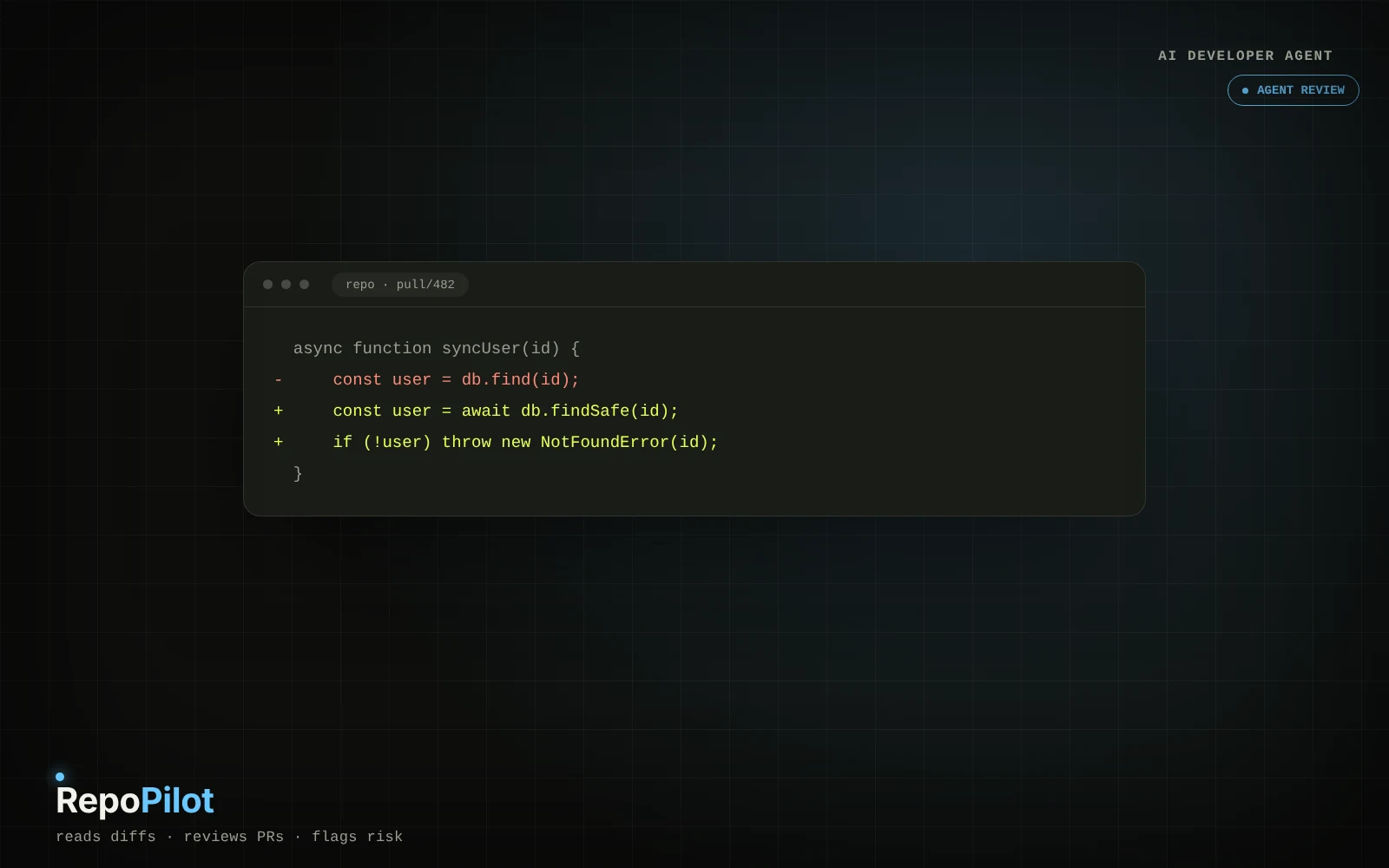
Conceptual cover artwork, not an application screenshot.
Overview
An AI agent that works inside a real codebase: it reads a repository, understands its structure, and carries out multi-step coding tasks — planning first, then editing files, running commands and checking its own work.
Features
- Reads a repo's file tree, dependencies and existing conventions before proposing any change
- Breaks a request into a short plan, then executes it step by step with tool calls (read, edit, run, test)
- Supports iterative tool use: it can run a command, read the result, and adjust course mid-task
- Surfaces its plan and diffs for review before anything is applied, rather than acting silently
- Designed to be model-agnostic, so the underlying LLM can be swapped without rewriting the agent loop
Technology
- TypeScript
- Node.js
- AI agents
- Tool calling
- ReAct
- Agent memory
- MCP
- Git and GitHub
The problem
Most AI coding assistants are chat windows bolted onto an editor — they suggest snippets but don't actually understand a project's structure or carry out a task end to end. Getting from "fix this" to a working, reviewed change usually still means a lot of manual copy-pasting and context-feeding.
Approach
RepoPilot is built as an agent loop, not a chatbot: it inspects the repository first (file tree, package manifests, existing patterns), drafts a short plan, and then works through it using a small set of tools — read file, edit file, run command — checking the outcome of each step before moving to the next. Keeping the tool surface small and explicit made the agent's behavior easier to reason about and debug than giving it unrestricted shell access from the start.
Outcome
The result is a repo-aware agent that can take on a real, scoped coding task — not just answer questions about code — while keeping its plan and diffs visible for review rather than acting as a black box.